
Reviewing the State of Reviews
PLUS: 5 Free Relics for Cairn!

I’ve found myself growing increasingly frustrated with the state of whatever we want to call how the internet discusses TTRPGs. Maybe that’s “critique.” Maybe that’s “reviews.” Or maybe it’s another better/worse third thing. Regardless, I’ve been less and less happy with what I’ve been engaging with on that front for the last several months (longer, really).
It feels like, too often, folks are talking past one another, write unclearly, choose to review a hypothetical product rather than engaging with the work itself, and refusing to really identify and address what they mean about almost anything they say. Without clear definitions and context, very little can be communicated.
I’m talking about a review in which someone read an adventure and spends their review criticizing it against a hypothetical box set edition - aw, how much better that would be! This is, largely, valueless as a review/critique of what actually exists (though it could be a portion of a piece about how you enjoy box sets over zines or something, I suppose). I’m talking about a review in which it’s very clear the GM has a preferred style they are unwilling to shift away from (and also unwilling to come to terms with), even in the name of reviewing a system that explicitly asks them to play in a specific way. I’m talking about the idea that a reviewer MUST have played a game or adventure to review it, even when those reviews in turn rarely offer detailed play reports or choose to contend with the players, their table, or even themselves as participants in their experience of turning the book into the game/play—whatever happens at the table (again, definitions are too fluid here).
I don’t believe we can easily use other medium’s critique as an analog for roleplaying games. People often compare TTRPGs to film. Recently, I saw someone says “system doesn’t matter” (a larger forever-argument I have zero interest in speaking to specifically, but go with me for a moment) is akin to saying “cinematography doesn’t matter,” but of course, TTRPGs are nothing like film and systems are nothing like cinematography. When I am playing a game at my table, almost everything is up to me and my group. If anything has a comparison in film, TTRPGs—the books on our shelves, the products, etc.—are perhaps most like scripts because, at the table, we are required to translate and often transform vast amounts of a work.
And yet, I also believe that it is the uniqueness (or perceived uniqueness) of TTRPGs that allows us to stunt our own growth. It’s the teenager screaming “no one understands me!” when, in fact, anyone who has ever been a teenager understands quite well. Too often, we (and by this I mean, me) have used this as an excuse to avoid deeper learning and simply attempt to sidestep the problem entirely, just as its easier to scream "I’m misunderstood” than it is to understand yourself.
In the past, I never wanted to engage with the academic or theoretical aspects of tabletop gaming. I would rather spend my time creating and playing them rather than argue over semantics and theoreticals online (which is how I was often exposed to this side of the hobby)—but now I am seeing the other side of that double-edged sword. We do not, widely, understand how to speak with one another. We do not, largely, understand how to speak to (and value) our own experiences, the impacts we have upon the games we play. We do not, often, understand how to speak to ourselves.
Despite the TTRPG-iverse’s judgement (like my own above) that we have too little critique and too little theory happening in the space, there is, in fact, a large amount of academic, critical, theoretical, etc. writing about tabletop games, much of which applies well to TTRPGs. It’s worth remembering that tabletop gaming is very old, especially in comparison to both video games and film.
I don’t have a grand solution to any of this yet, but I do have the means to hopefully uncover a solution in the months and years to come: read, learn, engage in good faith, see who has done the work, and follow in their footsteps.
My vow for 2026 is to finally do the damn work and dig into some of the more critical and academic writing that’s been done about games. I think you should too. This way, we can build a shared foundation of knowledge, create more universal definitions, and more fully and actively engage with our games, our selves, and each other. To do anything less is a disservice to all involved—and we deserve better.
I will be starting later this month with The Rule Book: The Building Blocks of Games by Jaakko Stenros and Markus Montola via MIT Press. It’s freely available HERE.
THE BLOGGING CONTINUES
This last month, I tossed another Stranger Stars design diary up on the MCGW blog along with some house rules for a new Cairn campaign I started with several coworkers who were looking for a more traditional DnD-type fantasy experience in their first game but I wanted to run Cairn (so much easier to learn)!
ZINE MONTH IS HERE
Once again, Zine Month, Zine Quest, Zinetopia, and any other zine-related monthly crowdfunding initiative I may have missed have arrived! Here are a few projects I either had a small hand in or got a chance to check out early:
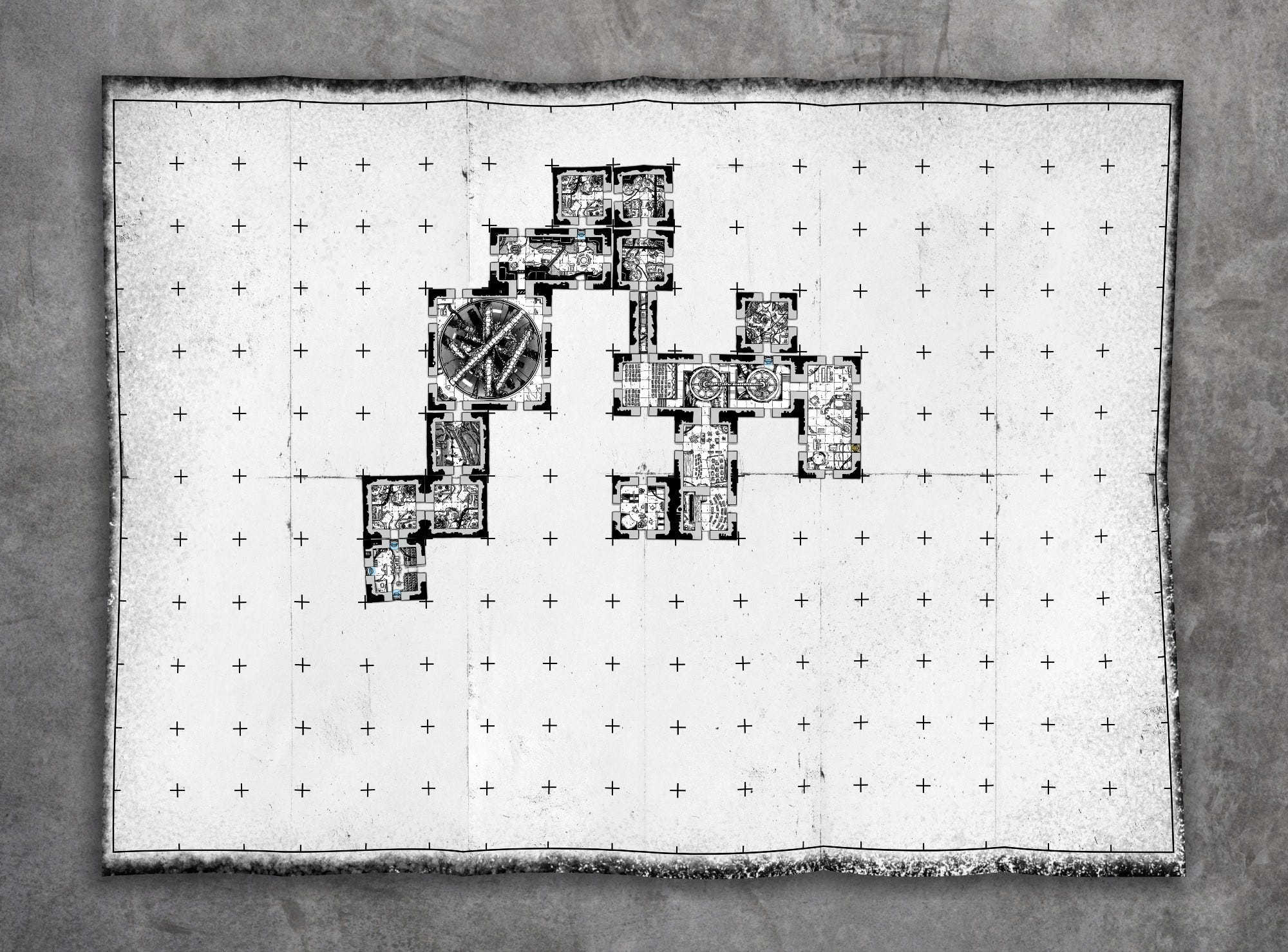
Twisting Unseen by Chris Airau, 5 Million Worlds Press
Way back when I did developmental work on this really unique Mothership adventure where the players, in universe (and at the table), build the environment around themselves using tiles and a big, blank map. It’s very cool and it’s crowdfunding NOW.
I’ll let Chris sell you on it further:
In Twisting Unseen, the players build the map, using cut-out map pieces while their PCs use the Gate Diagnostics Tablet, and configuring the facility's sectors and connecting tiles as they explore. Traveling their newly-built corridors exposes them to devious Incursors, biomechanical beings from other realities, while the Kagami sectors remain under the influence of the colony's descendant factions, who have forgotten skies exist.
Can the crew reach the Prime Gate before the continuum twists beyond their reality?
Von Hynd Manor
I got a chance to read the final version of this adventure and really enjoyed it. In fact, you’ll find a quote from me about it on the crowdfunding page:
"A gothic adventure of beasts in the woods human and otherwise, dripping with atmosphere and presented with clarity. There are dozens of reasons to visit Heivdorf and its surrounds but the one that most appeals to me is to enact justice, however difficult it may be to achieve."
It’s a deadly, creepy gothic adventure written to be played in any game of your choosing but they are offering up a bunch of conversions as part of the backing so even if you don’t feel comfortable running system-free stuff, they’ve got you covered.
This campaign is simply looking to finance a print run of an already digitally available (and complete) adventure. Personally, I think these kind of small, focused campaigns are much more in the original spirit of crowdfunding, and as such, I like to support them whenever I can. You should too.
FREEBIE: Relics of Arret Avon
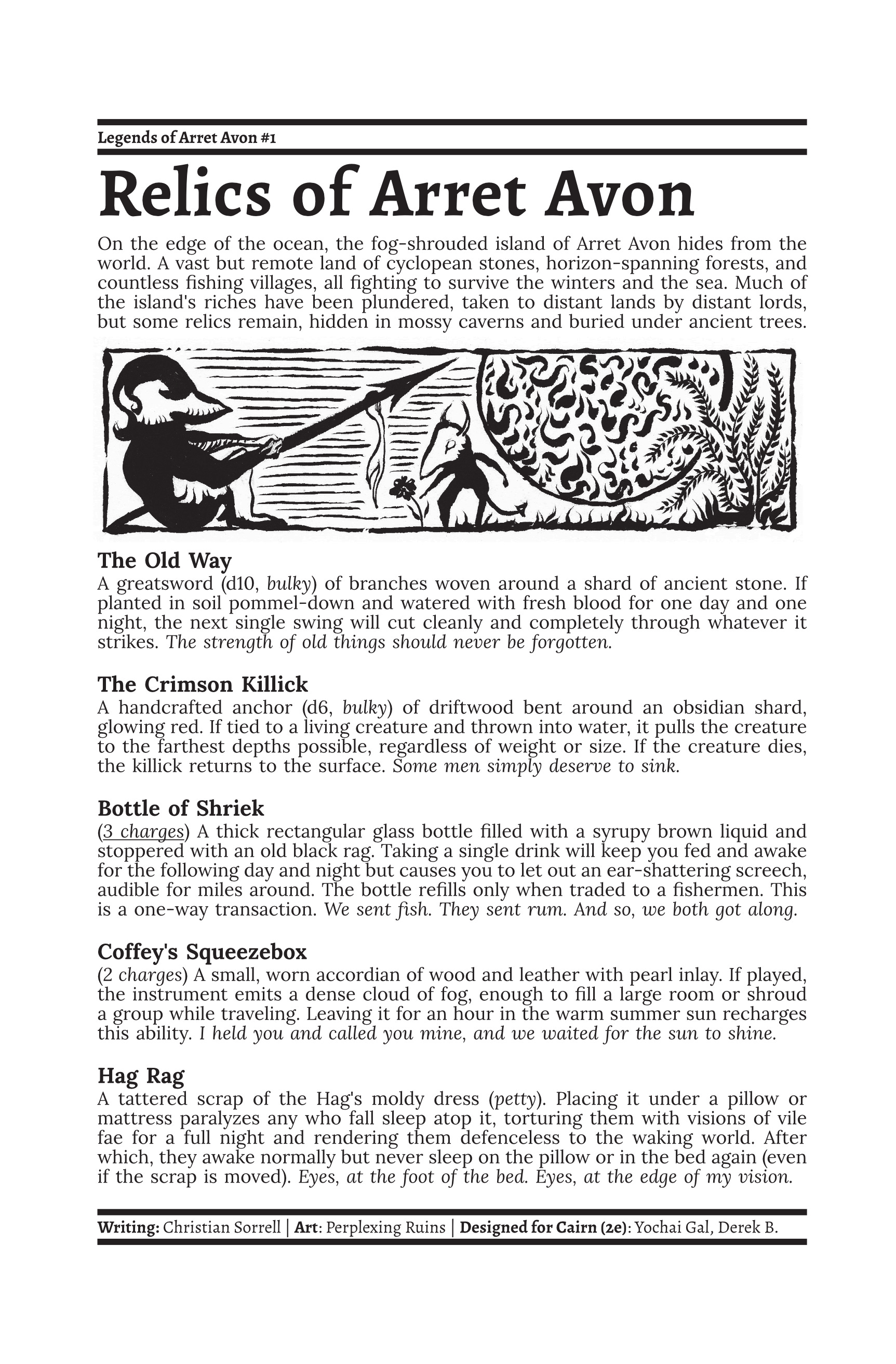
I have been playing and thinking about Cairn a lot lately. Here is a collection of five new relics created as part of one of my new campaign settings, Arret Avon - a Newfoundland-inspired fantasy setting for my campaign blending Cairn with a few more traditional DnD-ish elements. That said, these relics can easily stand alone in your core Cairn experience (or almost any fantasy game of your choice). Enjoy!
Download the full-quality version HERE!
The first relic here, The Old Way, is part of a small Cairn dungeon also set in Arret Avon that I’m hoping to drop as next month’s Freebie currently titled The House Among the Leaves. It’s the treetop lair of a perverted cult of wood watchers, known for raiding villages and capturing townsfolk to create a powerful army of their own using forest magic gone wrong. Stay tuned!
MORE COOL STUFF
MeatCastle GameWare Annual #3 is in stock now! The pre-order campaign was a huge success, allowing me to fund the print run of #3 and order a second run of Annual #2. Thank you to everyone who supported (your package is in the mail)!
Get your copy HERE!
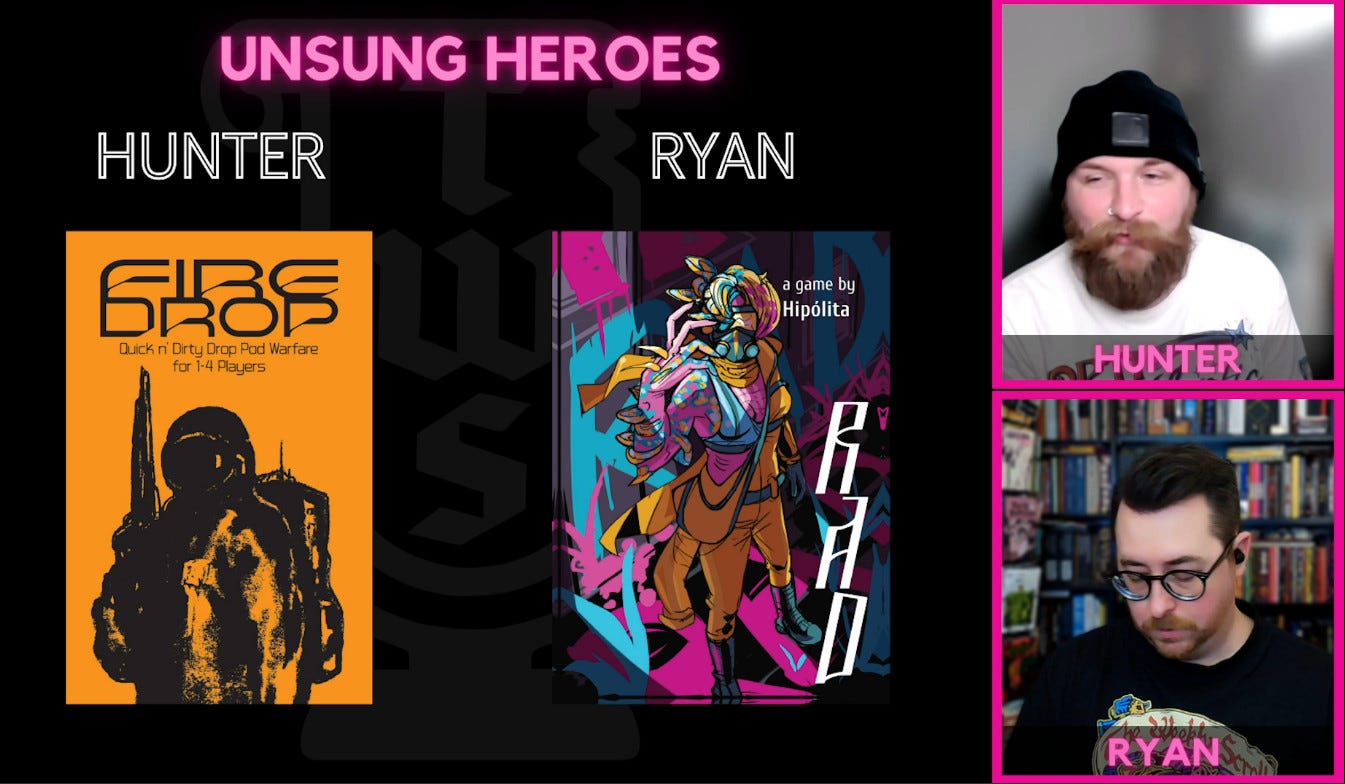
FIREDROP, my microgame of Helldivers-inspired drop pod warfare, was named an Unsung Hero of 2025 by Hunter over at The Weekly Scroll! Check out the full episodes with all of their recommendations from last year HERE.
I was a guest on Chris Airiau’s Ansible Uplink podcast where we reviewed one of the most underrated Mothership modules out there - Lone Archivist’s What We Give to Alien Gods. Listen to the episode above or head HERE to check out Chris’s Patreon.
Chaoclypse started a new video series about a campaign setting blending OD&D with Roadside Picnic/Stalker (including tons of his awesome art). It’s a great premise, and I’m dying to see more!
Alfred Valley created a video guide for collecting textures from the world around you, anytime and anywhere. It’s a wonderful bit of inspiration and a good reminder that we should always be building our creative eye.
I joined Ryan over at The Weekly Scroll to review HAMMERS: Bell, Book & Candle Edition by Jon Davis/ Sivad’s Sanctum. I really liked a lot of what this game’s got going on, and I’m excited to see it develop into its final form.
Rascal published an extensive article digging into a bunch of things gone wrong with the continued production of Possum Creek Games’ Yazeba’s Bed & Breakfast. It’s an interesting, often frustrating, read in its own right, but it also shows the continued trickle down effects of the PlusOneExp/Brandfox situation I was caught up in several years ago. If you aren’t subbed to Rascal, I’d recommend it.
HERE are some good words.
In the last Missive, I said “one day I’ll figure out how to write a piece that the blog folks put in their roundups,” and almost immediately thereafter, The Explorateur did. I also got a shoutout in Explorer Design’s Top 5 Newsletters post which was another bit of fun news. So that’s cool!
Cameron Kunzelman wrote about A Land Once Magic over at The AV Club. I had a great time playing the game myself recently, and I think it’s great to see this kind of game getting this kind of coverage on that kind of site!
I enjoyed reading this cranky and interesting post over at The Foot of Blue Mountain about how great adventures/modules don’t need to be easy to bring to the table. For the author, there is joy to be found in engaging and transforming the adventure to fit your table/play style. It had me thinking a lot about what I prioritize in my designs and how I’ve engaged with adventures myself in the past.
And lastly:
Thanks for reading! This has been a tremendously hard month—a dark start to the new year. Help one another, be kind to each other, and FUCK ICE. - Christian
For more academic-style writing about tabletop games, I highly recommend the series published by CRC and edited by Geoff Engelstein. Thematic Integration in Board Game Design (Shipp, 2024) and Cardboard Ghosts (Holland, 2025) are outstanding.
I have Graphic Design for Board Games and Worldbuilding for Game Designers on my TBR shelf.
I think you gesture at this but I genuinely think that the problem with a lot of what I'll call popular/factional ttrpg theory is that it frequently begins with one's own play experience, and so takes as axiomatic what works and doesn't work before any theoretical inquiry even begins. That's fine if all you're doing is defining your own area of interest, but trying to spin up a grand unifying theory from those personal axioms strikes me as deeply self-indulgent.
On the bright side, something I do see increasingly over the past few years is folks saying some version of, "It's not for me, but plenty of people enjoy it, so I'll assume it works," which is deeply heartening to me. The scene could always be better, but it used to be much worse, so I'll take what I can get!